
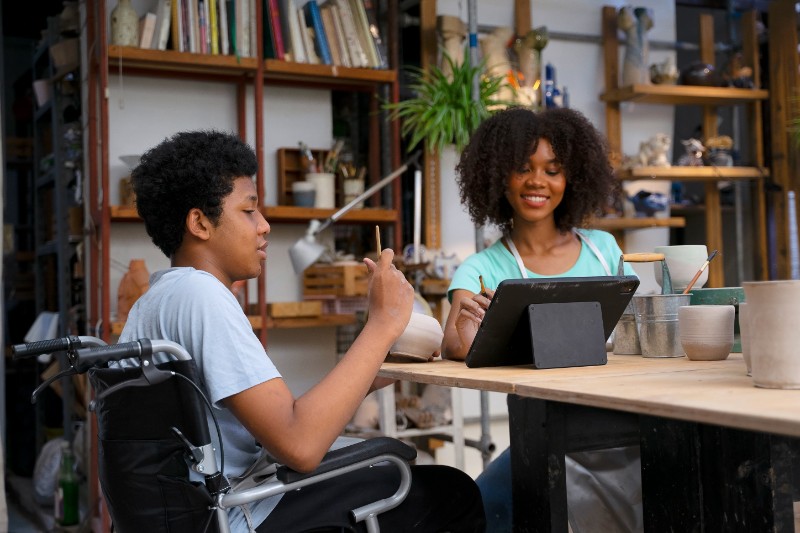
You watch your child reach toward a communication tablet, tap a picture, and hear the device say “more” out loud.
The voice is coming from the device, but the message is coming from your child, and it may be one you have waited years to hear.
The first time your child has clearly communicated what they want in a way everyone understands, can also be the moment new questions begin:
What is an AAC device? My child’s team uses ABA… do they also need a speech therapist? And the big one: Will a device stop my child from learning to talk?

This co-authored guide answers those questions from both an ABA therapy and speech-language pathology lens. For the speech-language perspective, we spoke with two clinical professionals:
Samantha Berardesca, a registered speech-language pathologist and Clinical Director at Talk Inc. She was joined by Mia Marconicchio, a Communicative Disorders Assistant registered with the CDAAC, who works with AAC users in homes and clinical settings.
Table of Contents
What Is an AAC Device? (A Plain-Language Overview)

AAC stands for Augmentative and Alternative Communication, any assistive technology that helps your child communicate when speech alone is not enough yet.
“Augmentative communication” means it adds to the dialogue a child already has, and “alternative communication” means it can stand in for speech when needed. Either way, the goal of an AAC device is to act as a reliable tool for your child to express what they want, need, and feel.
AAC devices range from low-tech options like picture boards and picture exchange systems (PECS) to simple electronic devices with a few recorded messages to speech-generating devices and tablet apps with a large, customizable vocabulary.
Importantly, AAC is not a last resort you reach for only after everything else fails. It is a communication system in its own right, and for many children, it becomes the most natural way they have ever been understood.
“Research consistently shows that adding AAC to a child’s plan doesn’t stop verbal communication; it supports it.”
– Samantha Berardesca
How ABA Therapy & AAC Work Together
AAC and ABA therapy often work closely together because communication is central to many ABA goals.
A Board-Certified Behaviour Analyst (BCBA) or Registered Behaviour Analyst (RBA) builds programs on the science of learning, and the same principles that teach any skill, reinforcement, prompting, gradual fading of support, and data tracking, are what help a child learn to use a device.
In practice, a therapist might model “go” on the device during a play routine, reinforce the child’s independent selection, then gradually fade the prompts so the child uses the word across different activities.
Communication goals are also where ABA and speech-language services overlap most. Behaviour analysts bring reinforcement-based teaching; SLPs bring deep knowledge of how language skills develop.
The best results come from an “AAC team”: the BCBA or RBA, the SLP, and the family working from the same plan. As Samantha put it, “It’s a team sport.”
There is even funding support for Ontario families, as many combine private speech services with Ontario Autism Program (OAP) funding and insurance coverage.
Top AAC Device Types for Children with Autism

There is no single “best” AAC device for every child.
The right option depends on your child’s communication needs, motor skills, language comprehension, daily environment, and the level of support available from family members, therapists, and school staff.
Here is an educational overview of the three tiers, with approximate Canadian prices.
Samantha’s SLP Perspective: There is no one-size-fits-all pick. The right system matches your child’s language comprehension, motor skills, and daily environment today, and they may move from low-tech to high-tech, or away from AAC, as their needs change.
Low-Tech
Low-tech AAC does not require batteries, charging, or electronics.
Examples include:
- Communication boards
- Picture symbols
- Core boards
- Flip books
- Customized activity boards
Low-tech tools are often portable, affordable ($30 to a few hundred dollars), and easy to use across different environments. They can also be a helpful backup when a high-tech device is charging, unavailable, or not practical in the moment.
Mia described low-tech AAC as especially useful for children who are accessing AAC, perhaps for the first time or just testing it out.
Mia’s Strategy
In sessions, she often uses low-tech boards for modelling. For example, during a play-dough activity, she might use a board with words such as “open,” “roll,” and “cut.”
Mid-Tech
Mid-tech AAC includes simple electronic devices that are usually battery-operated, with static displays and a set of pre-recorded messages, like “I want” or “I need”.
Examples include:
- Single-message buttons
- Sequential (step-by-step) message devices
- Multi-cell recorded-message devices
- Static-display talkers
Mid-tech devices typically cost between $200 and $700. Since the layout stays fixed, they are predictable and quick for a child to learn, making them a useful stepping stone toward a larger device.
Mia explained that mid-tech AAC is really great for kids who are figuring out cause and effect because pressing a button produces an immediate spoken result.
Mia’s Strategy
In sessions, she often uses them for predictable play routines. For example, after “Ready? Set…” a child can press the device to fill in “Go!”, then carry that same turn-taking pattern into greetings or shared reading.
High-Tech / SGDs (Speech-Generating Devices)
High-tech AAC uses dynamic display devices, often a tablet running dedicated communication software, to store a large, customizable vocabulary.
Examples include:
- Dynamic-display speech-generating devices (SGDs)
- AAC apps running on a tablet
- Dedicated speech-generating devices
These tools hold the most vocabulary and, as Mia put it, are incredibly customizable and can grow with the user.
An app on a tablet you already own can start around $250, while a dedicated device runs from $1,000 to $5,000 or more.
In Ontario, some communication aids may be eligible for support through the Assistive Devices Program after assessment and approval. Confirm your coverage before purchasing.
Mia’s Strategy
In sessions, Mia relies on lots of modelling to help a child learn where everything lives, since the vocabulary is usually organized into folders.
Fine-motor needs matter here too: some children use a physical keyguard over the screen to make accurate selections easier.
Core Vocabulary vs. Fringe Vocabulary: What Every Parent Should Know
Core Vocabulary
Core vocabulary is the small set of high-frequency words we use in almost every situation, regardless of the topic. As The American Speech-Language-Hearing Association (ASHA) notes, research shows that roughly 80 percent of what we say is communicated with only the 200 most basic words in our language.
Words like “more,” “want,” “stop,” “go,” and “help” sit here, along with most pronouns, verbs, and describing words.
They barely change from one activity to the next, and that is exactly what makes them powerful: a child who has core words can combine them in countless ways to build new sentences instead of repeating set phrases.
This is why core vocabulary is the foundation of most AAC programming.
Fringe Vocabulary
Fringe vocabulary is the personal, topic-specific layer on top of core: mostly nouns tied to a particular child, place, or interest, such as “cookie,” “iPad,” or “park.”
Research on children’s vocabulary use shows that, alongside a shared core vocabulary, each child has a large, highly individualized fringe vocabulary.
Fringe words make communication meaningful and motivating because they reflect what your child actually cares about, but on their own, they are limited. A board full of fringe words lets a child name things without being able to say much about them.
This is where the professions complement each other: SLPs bring developmental knowledge of when words come, and BCBAs and RBAs bring reinforcement-based teaching that helps them stick.
Busting Common AAC Myths
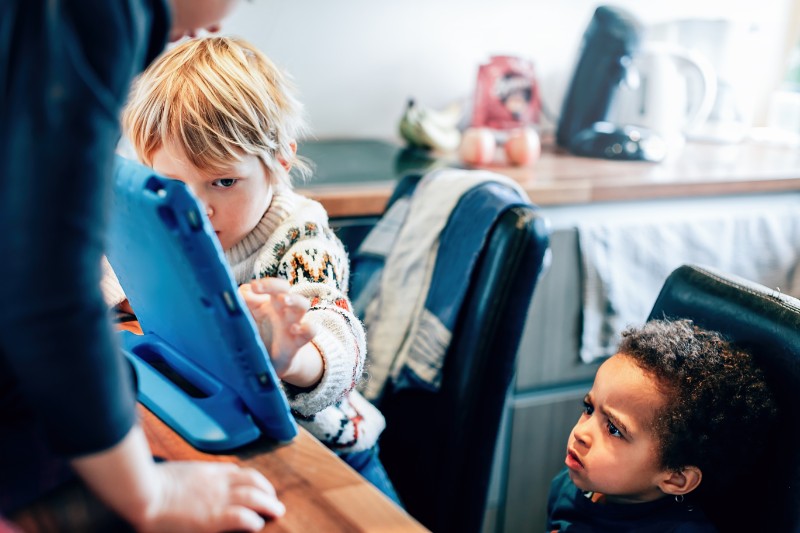
Many families are not against the idea of an AAC device; they are simply afraid of making the wrong decision for their child.
Here are some of the most common myths Samantha and Mia hear.
Myth 1: “If my child uses a device, they’ll never learn to talk.”
This is the fear the Talk Inc. team hears most, but the research does not support it. AAC is used alongside spoken language, not instead of it.
As Samantha explained, “If anything, it’s going to support their verbal communication development. It doesn’t replace it.”
Therapists model talking and the device together, and your child can always respond in whatever way works for them.
Myth 2: “An AAC device is just screen time.”
Screen-time limits exist due to concerns about passive entertainment, video watching, scrolling, and gaming.
An AAC device on a tablet is doing something completely different: your child is using it to speak.
As Mia put it, the device “is being used as a voice,” meaning it serves the same function as speaking out loud. As a result, it shouldn’t be lumped in with recreational screen time.
Myth 3: “My child isn’t ready for a device yet.”
Talk Inc.’s motto is “let’s not wait and see.” There is no readiness threshold your child must hit before a conversation with an SLP can begin.
Plus, starting early matters: 53.7 percent of Canadian children with autism are diagnosed before age five, the very window when early AAC and ABA support can have the greatest positive impact.
How Portia and Talk Inc. Work Together for Your Child
The collaboration between the Portia Learning Centre and Talk Inc. is built around a shared goal: helping your child communicate consistently across therapy, home, school, and daily life.
Effective AAC support depends on regular communication between the SLP or CDA, the ABA team, and your family. Speech professionals may only see your child once or twice a week, while your ABA therapy team often see them more frequently.
This makes collaboration essential. Therapists and caregivers can share observations from daily routines, helping the SLP or CDA adjust vocabulary, goals, and modelling strategies.
Mia noted that challenges often arise when team members are unfamiliar with the AAC system or when important updates are not shared. Consistent communication helps prevent this.
At Portia, our data-driven services can support AAC goals by tracking independent communication, prompting needs, and the generalization of skills across settings.
Most importantly, your family remains at the centre of the plan, with parent support and guidance built into the approach, because AAC does not stop when a session ends.
Families need practical ways to use the system throughout everyday routines, and Portia’s free ABA printables and resources are a great place to start.
Conclusion
The right AAC device matters, and it should fit your child’s needs.
A solid core vocabulary unlocks flexible communication, and the old myths, especially the fear that a device will silence speech, should not hold your child back.
Every child’s journey looks different, and as Mia reminded us, “it’s a learning journey for us too,” so there is no need to have it all figured out before you begin.
AAC and ABA work best when they are part of a coordinated team approach. If you have questions about whether ABA therapy and AAC could help your child, the best first step is a conversation.
Book a free screening with The Portia Learning Centre to get started, or complete Portia’s intake form to take the next step.
You can also visit Talk Inc. to learn more about speech therapy for autism, pediatric speech therapy and more.