
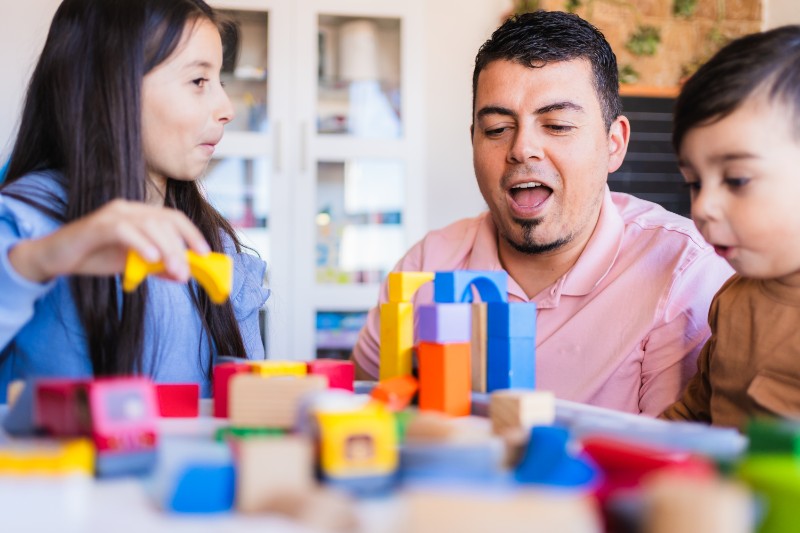
Your child is melting down in the middle of the grocery store. Their body is overwhelmed, their words are completely gone, and you can feel your own blood pressure rising.
What you do next matters far more than most people realize.
When children become upset, frustrated, anxious, overwhelmed, or dysregulated, they’re not giving us a hard time; they are having a hard time. Behaviour is often a child’s best attempt to communicate a need, solve a problem, or cope with a situation using the skills they currently have.
This article draws on the areas we integrate into our ABA programs every day at The Portia Learning Centre: applied behaviour analysis, co-regulation and self-regulation research, acceptance and commitment therapy, neuroaffirming practice, and child development research.
With autism prevalence among Canadian children and youth rising from 1 in 714 (0.14%) in 2000-2001 to 1 in 44 (2.25%) by 2023-2024, families are looking for calm, evidence-based support now more than ever before.
Think of this as a practical guide from our clinical team, where every co-regulation strategy here is one you can start putting into practice at home.
Table of Contents
What Is Co-Regulation?
Before children can regulate themselves, they first learn regulation through relationships.
Co-regulation is the process of helping a child manage their emotions, behaviour, and physiological responses through the support of a calm, trusted adult. Think of co-regulation as your child “borrowing” your calm.
Children are not born knowing how to:
- Manage frustration
- Wait patiently
- Handle disappointment
- Recover from mistakes
- Cope with uncertainty
- Solve problems calmly
These are skills that develop through repeated experiences with supportive adults. Just as children learn language through conversations, they learn emotional regulation through co-regulation.
The long-term goal is self-regulation, but self-regulation develops through thousands of moments of co-regulation first.
In other words, co-regulation is not a shortcut around the hard work. It’s the bridge that makes independence possible later.
Addressing the Stigma Around Behaviour Management

Many parents hear the phrase “behaviour management” and immediately think of punishment, compliance, or control. That association runs deep, and it deserves to be challenged.
Our role as parents, caregivers, and professionals isn’t simply to stop challenging behaviour. Our role is to understand what the behaviour is communicating, support the child through the moment, and teach the skills they need to be successful in the future.
That starts with a small shift in the question we ask ourselves. Instead of “What do I need to stop?” try asking “What does my child need?” This shift often changes the entire interaction.
A few principles anchor this approach:
- Co-regulation is not about controlling a child’s behaviour. It’s about providing the support the child needs to find their own emotional balance.
- The caregiver-child relationship is central, and it can’t be compliance-based. A relationship where a child is forced to submit to earn a reward is not the foundation we’re building on.
- ABA-informed co-regulation puts connection first. It’s a collaborative process, not a corrective one.
The ABA Perspective: Understanding the ABCs of Behaviour
One of the most valuable tools from ABA therapy is learning to look at what happens before and after behaviour occurs.
Behaviour analysts use a framework called the ABC Model.
A = Antecedent. What happened before? Examples: being asked to clean up, ending screen time, an unexpected change in plans, a loud environment, a difficult task, or a transition between activities.
B = Behaviour. What did the child do? Examples: crying, yelling, refusing, running away, hitting, or throwing.
C = Consequence. What happened after? Examples: a parent provided attention, a task was removed, the child gained access to an item, a parent offered comfort, or the environment changed.
The word “consequence” here simply means “what happened after”. Looking at all three parts helps us better understand why a behaviour may be occurring.
Going Even Deeper: Setting Events
Sometimes, the reason for a behaviour started long before the challenging moment. Behaviour analysts call these influences “setting events”; they increase the likelihood that a behaviour may occur.
They can include poor sleep, hunger, illness, anxiety, sensory overload, changes in routine, a difficult school day, social conflict, or medication changes.
For example, imagine two children are told, “It’s time to turn off the tablet.”
One transitions easily. One has a meltdown. The difference may not be the tablet. The difference may be that one child slept poorly, skipped lunch, had a difficult day at school, and is already overwhelmed.
When we understand the full context, behaviour often begins to make more sense.
What Need Is My Child Trying to Meet?
Most behaviour serves a purpose. Children typically engage in behaviour to meet one of four needs:
- Get Something: attention, connection, toys, activities, or sensory experiences.
- Avoid Something: difficult tasks, uncomfortable situations, uncertainty, social pressure, or sensory discomfort.
- Meet a Sensory Need: movement, touch, visual stimulation, auditory input, or deep pressure.
- Express an Emotional Need: safety, predictability, understanding, or support.
Understanding the purpose behind a behaviour helps us identify the skills that need to be taught. It also turns a confusing moment into useful information.
Connection Before Correction

When children are highly emotional, reasoning and problem-solving become much more difficult. Before teaching, correcting, or problem-solving, children often need connection first.
Connection might sound like:
- “You’re having a hard time.”
- “I can see you’re upset.”
- “That was disappointing.”
- “I’m here.”
- “You’re safe.”
- “We’ll figure this out together.”
Validation doesn’t mean agreeing with the behaviour. Validation means acknowledging the child’s emotional experience. You can validate feelings while still maintaining limits: “I know you really wanted more screen time. It’s okay to be disappointed. The answer is still no.” Children are more likely to learn when they feel understood.
This is also where a gentle reframe can help.
The goal is not to eliminate emotions. The goal is to help children experience emotions safely and learn how to respond to them effectively.
Instead of: “Don’t be upset.” → Try: “It’s okay to feel upset.”
Instead of: “Calm down.” → Try: “I’m here with you.”
Feelings aren’t the problem, and children don’t need us to remove every uncomfortable one. They need us to show them that they can feel something difficult and still move forward.
Why Co-Regulation Matters for Autistic Children
Co-regulation is foundational for every child, but for autistic children, it’s often essential.
Many children with autism experience intense emotions or have difficulty interpreting their own internal cues, sometimes leading to meltdowns, avoidance, or challenging behaviours.
This includes interoception, the ability to read internal bodily signals such as hunger, tension, or overwhelm. When those signals are harder to notice or name, an external co-regulator becomes even more important.
How Caregivers Can Help
This is why caregivers play such a crucial role. In stressful moments, an adult often acts as a child’s external nervous system, helping to manage their emotions, attention, and behaviour through a steady, supportive presence.
Each time you co-regulate, you also show your child that you are safe and trustworthy, laying the groundwork for self-regulation over time.
There is a biological side to this, too. According to the Child Mind Institute, a calm caregiver can directly influence a child’s stress response, including the production of the stress hormone cortisol, while nurturing touch can raise oxytocin, the hormone that helps us feel safe and connected.
Some of this happens automatically through mirror neurons, the brain cells that help us imitate and attune to the people around us. In practical terms, your regulated presence can help settle your child’s nervous system in real time, which is exactly why your own calm matters so much.
Did You Know? A 2023 Ontario study of 1,810 primary caregivers of autistic children captured just how heavy this work can feel, with many caregivers describing themselves as “exhausted, worn out, and broken.” If some days feel like too much, you are not alone, and you are not failing.
Practical Co-Regulation Strategies
This is the part most parents want to save. The right co-regulation strategy shifts as your child grows, so here is how to think about it by developmental stage, with an ABA lens throughout.
For Young Children (Toddlers & Preschool)
- Provide warmth and nurturing, and anticipate needs before they boil over.
- Offer structure and a consistent routine, which lowers uncertainty.
- Give physical and emotional comfort during distress. Speak calmly and offer affection.
- Label emotions out loud, model waiting, and use gentle redirection.
For Elementary-Aged Children
- Help with problem-solving as academic, behavioural, and social situations get more complex.
- Model conflict-resolution strategies in the moment.
- Prompt and coach coping skills and calm-down strategies, including self-talk and relaxation.
- Teach and support organization and planning skills.
For Adolescents
- Offer a warm, responsive relationship with support and empathy during intense emotion.
- Model more sophisticated self-regulation skills across different settings.
- Give time and space to calm down during conflict rather than forcing resolution.
- Monitor and prompt the use of organizational and planning skills.
The Role of Caregiver Self-Regulation
To best support your child, realize that you can’t pour calm from an empty cup.
Caregivers usually need to regulate their own emotions first because a calm, steady presence can soothe a child biologically and behaviourally, lowering stress and preventing escalation.
This is the biological synchrony described above at work, where a regulated adult helps stabilize a child’s nervous system through the mirror neuron system in real time.
This is often the hardest part of co-regulation, and it is completely understandable if it doesn’t come easily. Regulating yourself while your child is dysregulated is a skill, too, and one you can practise.
Being a calm anchor for your child doesn’t mean you never feel overwhelmed. It means you have a plan for the moments when you do. You can extend these strategies at home with Portia’s free ABA printables and resources.
Supporting Sensory Regulation
Many behaviours are influenced by sensory needs. Some children seek sensory input. Others avoid it.
Signs a child may need sensory support:
- Covering ears
- Seeking movement
- Crashing into objects
- Difficulty sitting
- Fidgeting
- Sensitivity to noise or clothing
Helpful supports may include:
- Movement breaks and walks
- Swings
- Fidgets
- Noise-cancelling headphones
- Deep pressure activities
- Visual schedules
- Quiet spaces
It’s essential to know that sensory supports are not rewards. They’re tools that help children regulate and participate successfully.
This ties directly back to the ABC model. Sensory overload is frequently a setting event, quietly raising the odds of a difficult moment before it ever happens, so meeting a sensory need early is often the most effective co-regulation strategy.
The Portia Regulation Framework
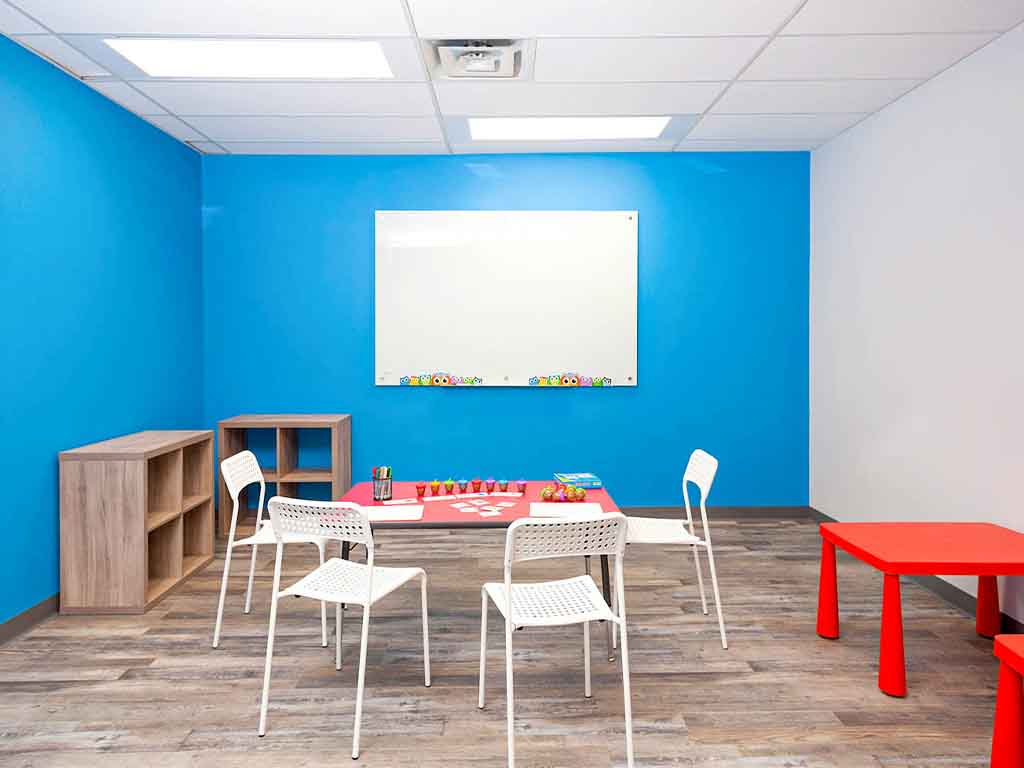
When your child is struggling, it helps to have a simple sequence you can return to. This is our signature framework at The Portia Learning Centre.
Step 1: Regulate
Focus on safety and connection. Stay calm, lower your voice, reduce demands, and offer support.
Step 2: Understand
Ask: What happened before? What need is being communicated? Are there sensory or emotional factors involved?
Step 3: Validate
Allow feelings without judgment. Validate emotions, normalize frustration, and maintain boundaries.
Step 4: Teach
Identify the skill that is missing. Ask: “What does my child need to learn here?”
Step 5: Practice
Practice skills when your child is calm. Learning happens outside the crisis.
Step 6: Reinforce
Notice and celebrate progress. Small steps matter.
Building Skills Instead of Simply Reducing Behaviour
One of the biggest misconceptions about behaviour support is that the goal is to eliminate behaviour. At Portia, our goal is to teach skills. Every challenging behaviour points us toward a skill that may need support.
| Instead of… | Teach… |
|---|---|
| Crying for help | Requesting help |
| Hitting | Expressing frustration |
| Running away | Requesting a break |
| Screaming | Emotional vocabulary |
| Grabbing | Waiting and requesting |
| Refusing | Flexible thinking |
| Melting down during transitions | Transition skills |
| Yelling for attention | Appropriate attention seeking |
The question isn’t: “How do I stop the behaviour?”. The question is: “What skill should replace it?”
Teaching Functional Communication
Communication is often one of the most powerful replacement skills.
Children can learn to say:
- “Help, please.”
- “Can I have a break?”
- “I’m frustrated.”
- “Can I have a turn?”
- “I need space.”
When communication becomes easier and more effective than challenging behaviour, behaviour often improves naturally.
Co-Regulation vs. Self-Regulation
Parents often ask how co-regulation differs from self-regulation and where their child fits into it.
Self-regulation is the ability to independently recognize, manage, and respond to one’s own emotions and impulses. It takes years to develop, and it builds on a foundation of successful co-regulation experiences.
Children don’t start with self-regulation. They need repeated co-regulation experiences before they can begin to manage their emotional states on their own.
Put simply, co-regulation is the foundation, and self-regulation is the goal. ABA helps build the bridge between the two systematically and measurably, with detailed data collection to track progress over time.
It also helps to redefine what progress looks like, because many parents feel discouraged when their child still struggles.
Children will continue to have difficult moments. That’s part of development. Progress may look like recovering faster, asking for help sooner, using words instead of behaviour, accepting support, tolerating small disappointments, or trying a coping strategy. Every small step matters.
How ABA Supports Co-Regulation at Portia
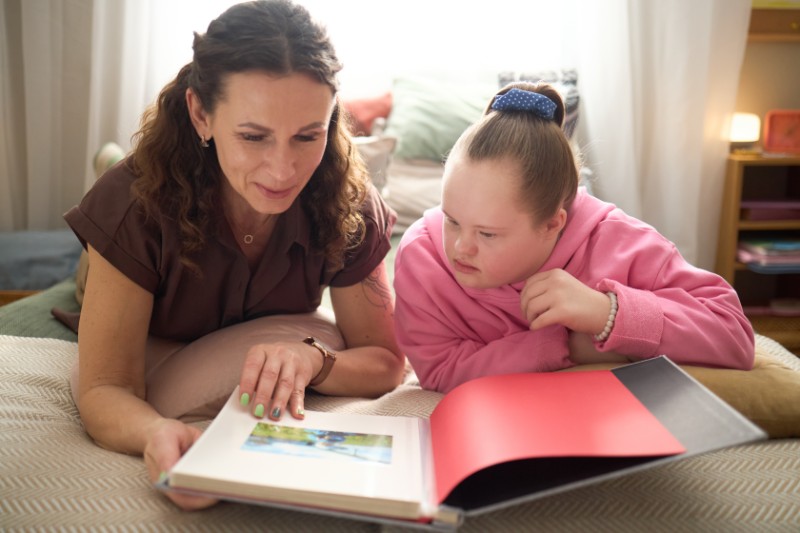
Everything above is something you can practise at home. It’s also the daily work of the Portia clinical team, who model co-regulation within every session, showing children what a calm, supportive response feels like.
However, parents are the most important co-regulators of all. For this reason, parent training and support is built into the program, so you can carry these strategies home with confidence.
With ABA being data-driven, we track progress in regulation over time and adjust as your child grows. Every program is personalized for each child, with a focus on communication, social interaction, daily living skills, and academic learning.
Early support makes a measurable difference here. By 2023-2024, the rate of newly identified autism cases in Canadian children aged 1 to 4 reached 689 per 100,000, surpassing the 5 to 9 age group and reflecting a growing emphasis on early identification.
At The Portia Learning Centre, we believe children do well when they can. When a child struggles, we ask:
- “What is the behaviour communicating?”
- “What need is being expressed?”
- “What skill is missing?”
- “How can we support learning?”
We focus on understanding before reacting, connection before correction, and teaching before expecting.
Because every behaviour tells a story, and every child deserves to be understood.
Frequently Asked Questions
What is co-regulation in ABA therapy?
Co-regulation is the process of helping a child manage their emotions, behaviour, and physiological responses through the support of a calm, trusted adult. In an ABA context, it means using warm, responsive interactions to support a child through a difficult moment while also teaching the skills they need for next time. Think of it as your child borrowing your calm until they can build their own.
How does co-regulation help children with autism?
Many autistic children experience intense emotions or have difficulty reading their own internal cues, which can lead to meltdowns, avoidance, or challenging behaviour. A calm adult can act as an external nervous system, helping to steady the child’s emotions and stress response in real time. With repetition, these experiences build the foundation a child needs to eventually regulate on their own.
What is the difference between co-regulation and self-regulation?
Self-regulation is the ability to independently recognize and manage your own emotions and impulses, and it takes years to develop. Co-regulation is the supported version that comes first, in which a trusted adult provides the calm and structure that the child cannot yet provide for themselves.
How can parents use co-regulation strategies at home?
Start by connecting before correcting: acknowledge the feeling before trying to solve the problem. Stay calm, lower your voice, reduce demands in the moment, and validate the emotion while keeping your limits in place. When your child is calm again, that’s the time to practise the missing skill, whether it’s asking for a break, waiting, or using words instead of behaviour.
At what age should co-regulation strategies start?
Co-regulation begins in infancy and continues in different forms right through adolescence. For toddlers and preschoolers, it looks like comfort, routine, and simple emotion labelling. For older children and teens, it looks like coaching coping skills, modelling problem-solving, and giving space to calm down. It’s never too early or too late to start.
Does ABA therapy teach co-regulation?
Yes, ABA-informed co-regulation puts connection first and uses the science of learning, including reinforcement, prompting, and skill-building, to teach emotional regulation over time. At Portia, our team models co-regulation in sessions, coaches parents to use it at home, and tracks progress with data, so families can see what’s genuinely working.
What is the ABC model in ABA therapy?
The ABC model is a simple framework for understanding behaviour by looking at the Antecedent (what happened before), the Behaviour (what the child did), and the Consequence (what happened after). Here, “consequence” simply means what happened next, not punishment. Looking at all three parts together helps parents and clinicians understand why a behaviour is occurring instead of guessing.
What is a setting event in ABA?
A setting event is an influence that started before the challenging moment and increased the likelihood that a behaviour would happen. Common examples include poor sleep, hunger, illness, anxiety, sensory overload, or a difficult day at school. Two children given the same instruction may respond very differently, and the setting event is often the reason why.
Take the First Step
If you recognize your child in what you’ve just read, the most helpful next step is a conversation. Understanding your child’s big feelings is the beginning, and you don’t have to navigate the rest alone.
When you’re ready, book a free screening with The Portia Learning Centre, or complete an intake form, and together we can build the right support around your family.
In the meantime, there’s more you can do today:
Share this article: If this helped you, please share it with a partner, caregiver, grandparent, teacher, and anyone who helps care for your child. Co-regulation works best when everyone is speaking the same calm language.